Learning map · built from Sheldon's research of public sources3 November 2026 · no robot was tested
Robotics, from the parts to the paying customer
A map of the robotics industry for someone new to it: the bodies robots have, what is inside one, and who gets paid along the way.
The point
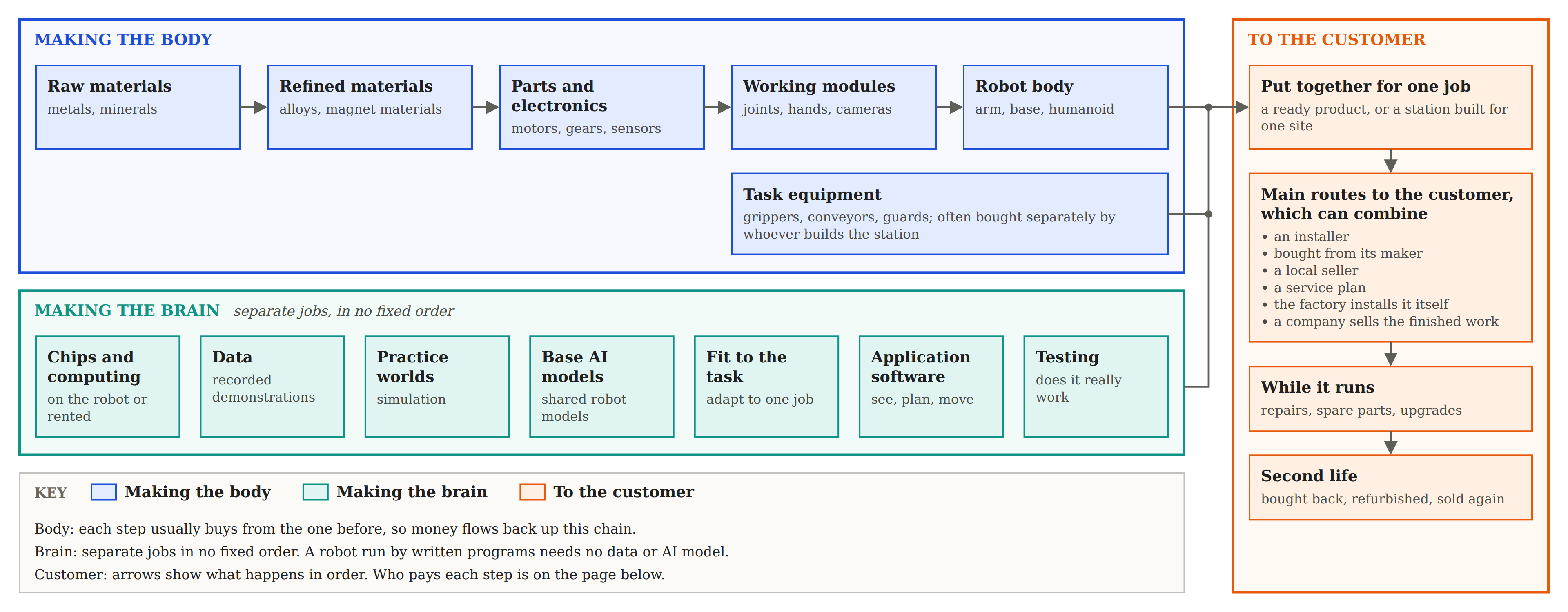
Robotics is not one industry but many companies doing different jobs. Two supply chains, one for the robot's body and one for its brain (the computers, software and AI that decide its moves), meet in a working setup for one job: a ready product, or a station built for one site. Then other companies sell it, install it, finance it and maintain it for a customer. One company can do several of these jobs.
Why it matters: a robot's own price is only part of what a customer pays, because installing it and running it (energy, spare parts, repairs, the people around it) cost money too. Seeing the whole chain also stops two easy mistakes: thinking humanoids, or one AI model, are the whole industry.
Three real examples, followed through every view. Pick one.
The tags describe the evidence, not a roadmap. Working today a customer or a maker's published case describes real use, not how widely or whether it still runs (an old case shows its date). Tested in a pilot a trial. No published proof yet the research found none, for example of any humanoid doing many different jobs. Each example rests on one published case, none says how often people step in to help, and much of the evidence on this page is the makers' and customers' own accounts.
1 · See the industry: robot bodies
A common way to group robots is by body, in ten families. The list is not complete and some families overlap.
Four questions describe any robot
Its body: often one of the families above.
Its job: what it does, for whom.
Who or what decides its moves: a person at a remote control, a written program, sensors, learned behaviour, or a mix.
What the evidence shows: a demonstration, a pilot, or real repeated use.
"Humanoid" answers only the first question. "Construction" answers only the second.
A few numbers and a word
About five million industrial robots were working in 2025, according to the International Federation of Robotics. That is its count of industrial robots only: the federation counts service robots separately, and it is not a count of humanoids. industry body
More than 600,000 were installed that year, 59% of them in China; the United States, Japan, South Korea and Germany were the next big markets. In 2024, electronics and car making bought the most, then metal and machinery. industry body · industry body
So the field mixes countries: a Japanese parts supplier, an American AI company, a Chinese robot maker and a local installer can all take part in it.
"Cobot" means built to work near people. It does not mean the robot uses AI, and it does not make every tool on it safe.
Factory robots started with Unimate, sold to General Motors in 1961 to handle hot metal. museum
Where robots work
Pick an industry. You see what robots already do there, what the research judges gets harder next, and the named cases the research found, each with its body and tag. The lines on what robots already do come from the research's summary of industry reports.
2 · Look inside a working robot
Take the research's example of a robot packing a mug. It repeats a loop:
Sense the scene. Cameras and other sensors measure the room and the robot's own position.
Find the mug. Software recognises it and works out where it is.
Plan. It chooses the steps and how to grip.
Move. Motion control turns the plan into movements each joint can make.
Check the result. Feedback catches a slip, a bump or an unfinished job.
Separate from the loop: safety. Independent safety functions limit what the whole machine is allowed to do.
This loop is the research's own explanation. Other robots run similar loops with their own steps. Newer AI models can do several of these steps at once; that does not make them the safety part.
What a robot body is made of
Motors make the movement, gearboxes trade speed for force, encoders (small sensors) measure each joint's position, cameras and sensors see, a computer decides, batteries power a robot that moves, and a hand or tool does the work. That is why each of these has its own suppliers (view 3).
How a robot is told what to do
When no person steers it, a robot gets its behaviour in five overlapping ways. The research describes robots as having long used programs and sensors to adjust, and the new wave as adding learning to cope with much more variation. Our sources do not say which ways each of our three examples uses.
Way
How it gets its behaviour
When the job changes
Used for a long time
Written program
People write the movements and the order of steps.
Someone rewrites and checks the program.
Sensor-guided control
Software reacts to measured position, force or obstacles.
Settings and plans may need adjusting.
The new wave
Learning from examples
A model learns from demonstrations of the task.
More demonstrations may be needed.
Learning by practice
A model improves from feedback, often first in a practice world on a computer.
Someone must define what success means, and it still needs checks on the real machine.
Shared AI model
A base model, a general robot AI trained on lots of data, brings what it learned.
Each robot and task may still need data, tuning and testing.
Where the AI runs
Training changes the model using examples and feedback. Running it means the trained model making the robot's decisions during work. They are different bills.
Running it can happen on the robot (its own computer, power and cooling) or on a distant server (a connection, a model service, and a plan for delays or a lost connection). Fast control and safety can stay on the machine even when the AI runs on a server. Neither is automatically cheaper. Google · Hugging Face
Where the learning material comes from
Recorded demonstrations: what the robot saw and how a person moved it.
Practice worlds on a computer (simulators): repeatable virtual situations to practise and test.
Internet images and video: help it recognise things and understand instructions, but they do not by themselves supply the right motor movements and forces.
None of these replaces testing the real machine.
Three names people mix up
They are three different kinds of thing.
A company
Physical Intelligence builds robot AI models for other companies to use, a bit like Anthropic for text. By its own announcement, its October 2026 beta, open through a waitlist, adapts a model to your task and runs it for you; no public price. You still need the robot, the task and the setup. maker
A free toolkit
LeRobot is Hugging Face's free toolkit to connect robots, record demonstrations, train models and run them. Think of it as the workshop; SmolVLA is one AI model you can use in it. maker
A technique
LoRA is not a product. It is a way to adapt an AI model cheaply, using less computing. explanation
3 · Follow the money: the chain
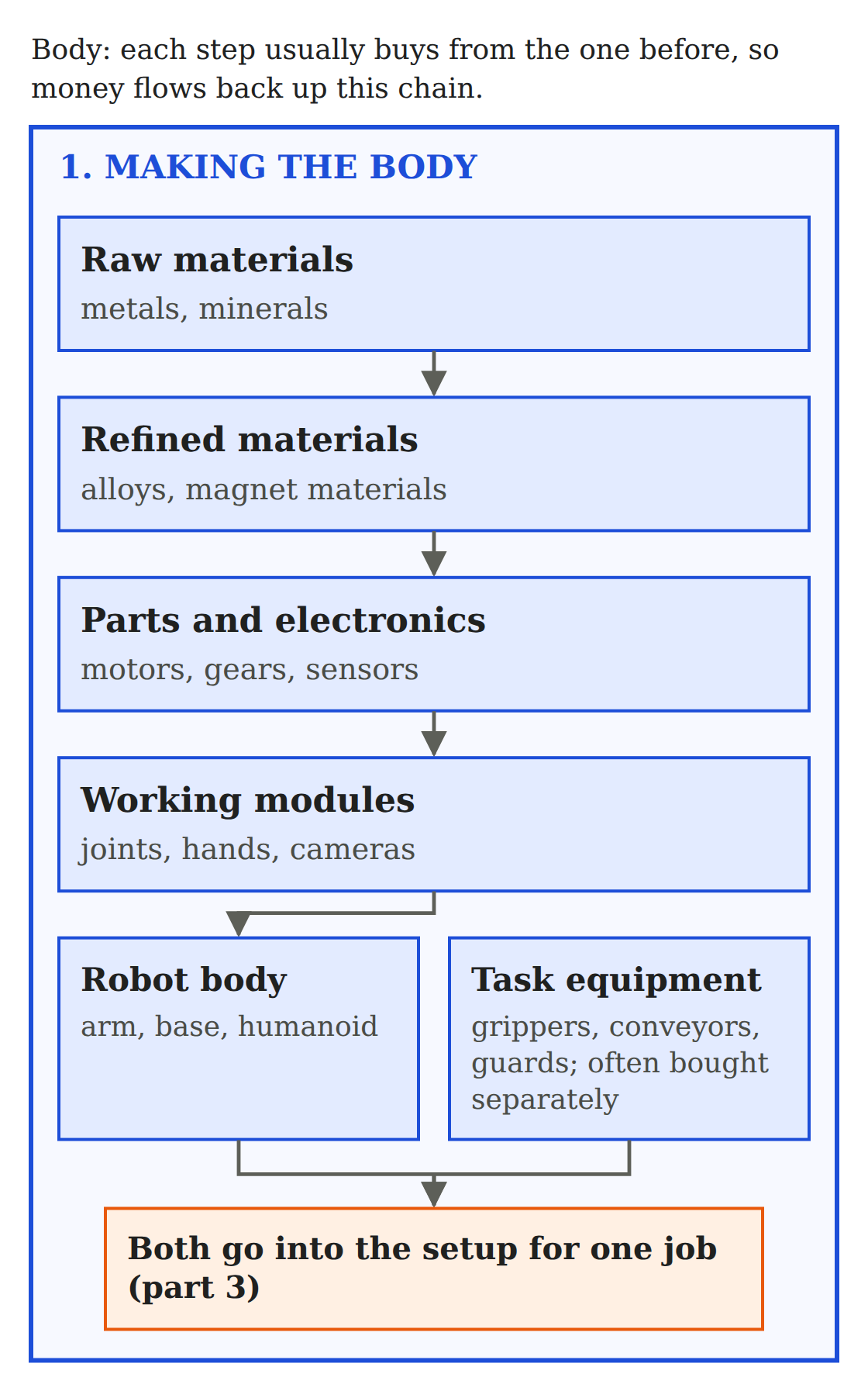
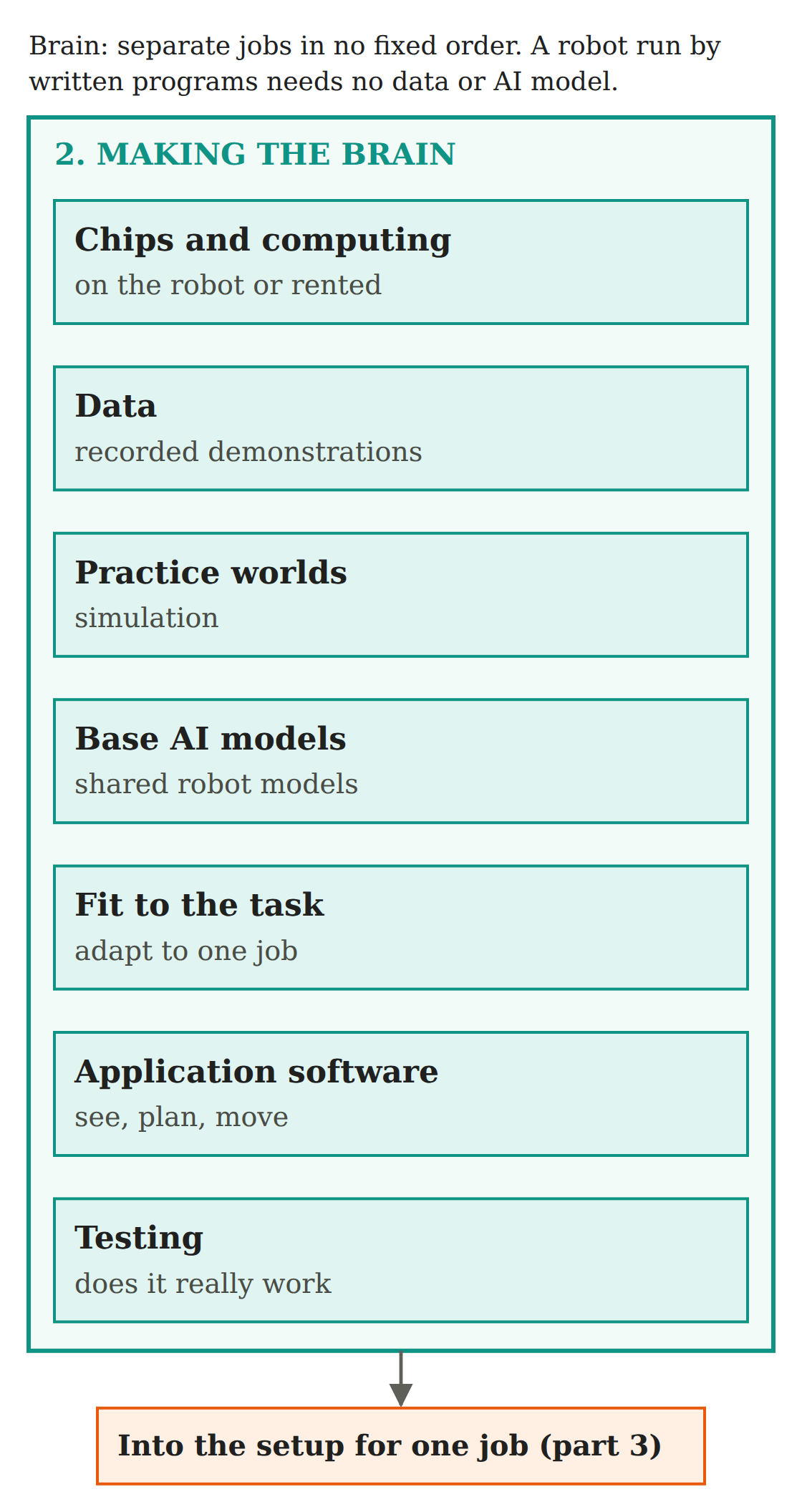
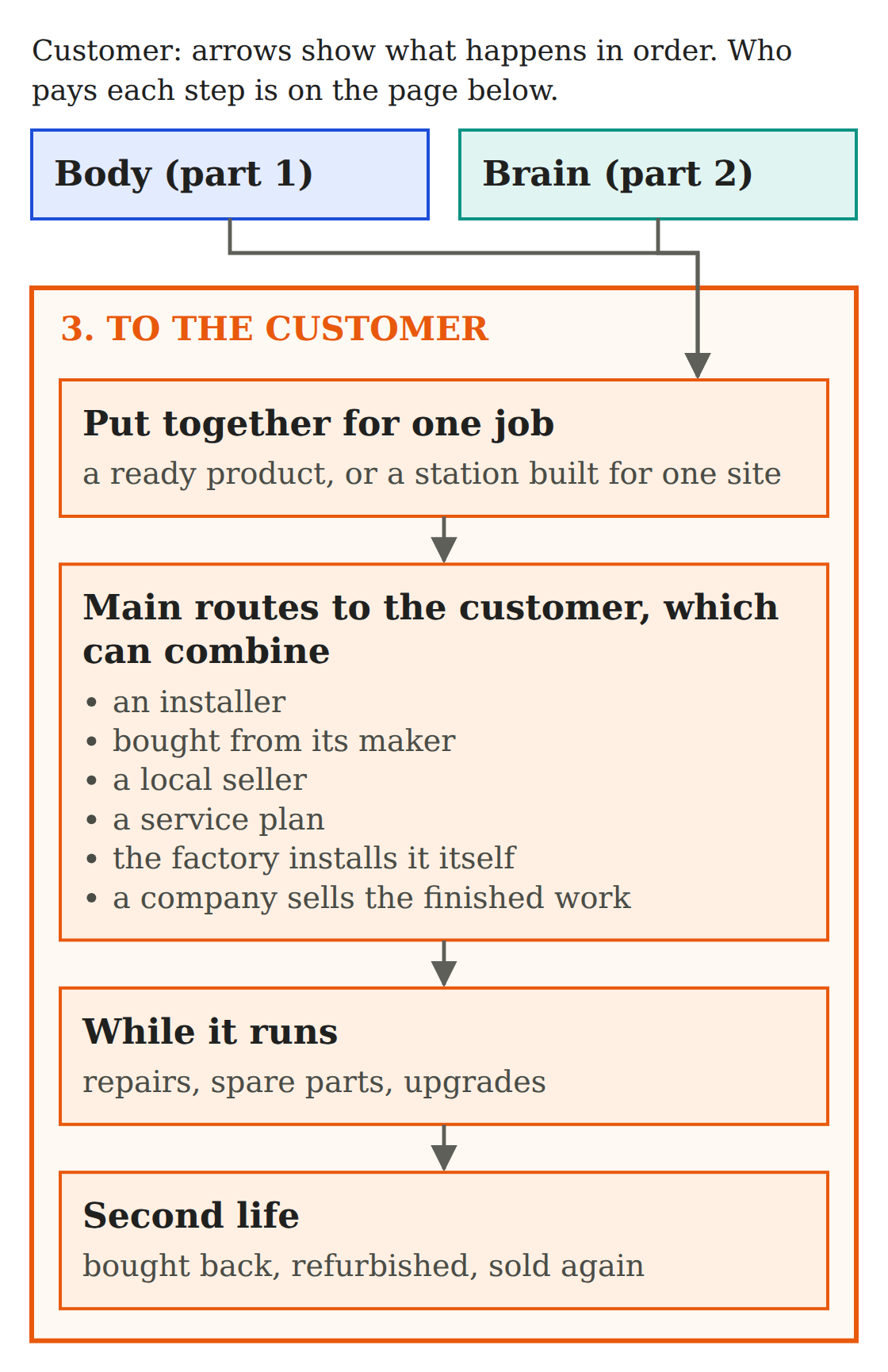
Two chains meet in a setup built for one job, a ready product or a one-off station, then it reaches the customer. Not every robot uses every step: a robot run by written programs needs chips and software, but no training data or AI model.
How a robot comes to exist, and how it reaches a customer. Open the diagram full size. Open any step below for what it is, an example company and who pays it. In the body chain each step usually buys from the one before, so money flows back up it. The brain steps are separate jobs in no fixed order. The research names an example company for nine of the thirteen steps in making the body and the brain; they are examples of each role, not the leaders, not the full set, and not who supplies whom.
Making the body
Making the brain
Getting it to the customer
Who pays whom
For a pallet-stacking station, the research gives one possible path: the factory may pay one installer, who pays the makers of the arm and equipment and its own engineers; the arm maker pays its parts suppliers. A lender changes when the factory pays, not the costs underneath, and the financing has its own cost. An AI model fee, where there is one, may sit inside the product maker's bill.
This shows who pays whom, not how much each earns. The same money passes through several companies, so their sales cannot be added up into one market size. Money investors put into robot companies is not money customers spend on working robots.
Once, or again and again
Some payments happen once, like buying a machine. Others repeat, like service, spare parts, leases or access to an AI model. Example: the surgical-robot maker Intuitive reported 84% of its 2025 revenue as recurring, mostly instruments and accessories, then service and leases. That is one surgical company, not a rule for factory arms or humanoids. maker's filing
Two single companies, not market sizes: Teradyne's robot business (Universal Robots and Mobile Industrial Robots) sold US$308 million in 2025, down from US$365 million in 2024, mainly from lower cobot and mobile-robot sales. maker's filing Intuitive's total revenue was about US$10.1 billion. maker's filing Their businesses differ too much to rank one against the other.
The research found that free tools cut the cost of rebuilding common software, not the cost of hardware, computing or people: LeRobot is free, but the robot and the people to set it up are not.
Follow the money: the bills
Money is spent at four moments. All prices on this page are public offers or a maker's estimate, not quotes.
Before the product exists
Research, prototypes, factory tooling, general training data, building AI models.
Paid by the maker or model company, with investors' money, own cash, loans or early customers.
For each machine
Parts, assembly, testing, delivery, warranty.
Paid by the manufacturer, then recovered through its sale or service.
At each customer site
Designing the station, tools, connecting it to existing machines and software, tuning, checks, training staff.
Paid by the customer, or by a company selling it as a service.
While it runs
Energy, parts that wear out, software or cloud fees, people, repairs, downtime, upgrades, disposal.
Paid by the owner, sometimes partly through a service contract.
The fair way to compare robots: the whole cost of owning and running one, divided by the work it does right (boxes stacked, floors cleaned, inspections delivered), counting the times people step in and the time it stands still. A low price or a fast movement alone says little.
One extra example: buying versus the seller's monthly plan
Gausium's floor-cleaning robot, sold in the US by RobotLAB: from US$53,600 to buy, or US$979 a month for 36 months (about US$35,200 in total). The two offers may not include the same things, such as who owns the robot and what service comes with it, so the lower total does not show the monthly plan is cheaper. seller
For a robot running a new AI model, the research found no published all-in cost, and no published split of money between hardware, AI, installation and support.
What may come, and the limits of this page
The research's own scenarios if current progress continues. They are not forecasts.
By
Possible if progress continues
What would make it real
November 2028
More ready-made robot products, easier teaching, more mobile and humanoid robots at work, each in a narrow role, many still in trials.
Less setup work, robots working whole shifts, people stepping in less often.
November 2031
Robots reused across more jobs, in places that change, if they become reliable and cheap enough.
Customers buying again across many sites, enough repair and support capacity, a good full running cost.
Slower path
Better demonstrations and models, but deployment stays expensive and narrow.
Wear, failures, adapting and support eat the savings.
How the money may shift, in the research's view: easier teaching could cut some custom programming while raising spending on data, computing, testing and running the robot. A part may get cheaper while the whole job stays expensive. These are ideas to test, not findings.
Limits. We did not test any robot ourselves. Much of the evidence is the makers' and customers' own accounts (DPR, for one, says it has a stake in Dusty's maker). Prices are public offers or a maker's estimate, not quotes. How often people step in to help a robot is rarely published, and so are AI model prices and how the money splits along the chain.
Sources, by who wrote them
Built from Sheldon's research report of 3 November 2026 and its notes on robot types and money, which read these pages on that date.